


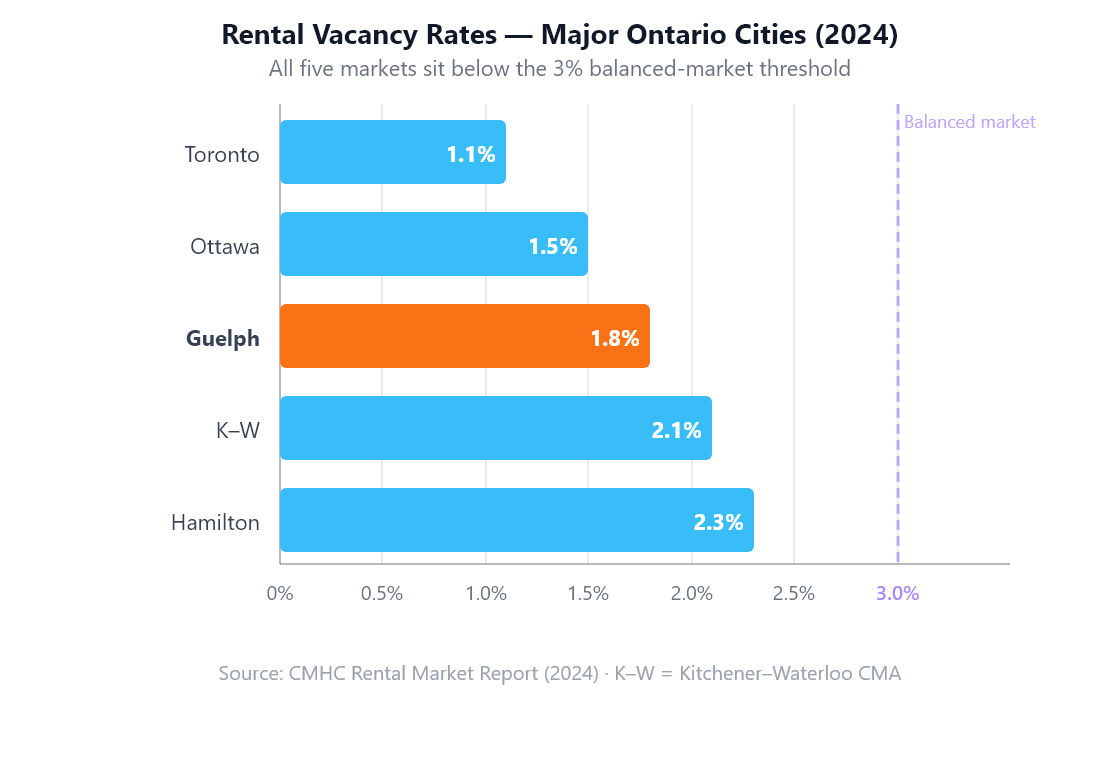
Guelph’s rental vacancy rate sits below 2%—well under the 3% threshold considered a
balanced market (CMHC, 2024).
That’s a landlord’s market on paper. But it only translates into real returns if your
property is priced correctly, maintained before problems compound, and occupied by a
tenant who stays. Many owners across Guelph, Wellington County, and the Waterloo Region
self-manage and quietly absorb preventable losses—vacant weeks, deferred repairs, and
below-market rents. A professional property manager doesn’t just handle the day-to-day.
They systematically protect and grow the equity you’ve already built.
- Precision rent pricing — capturing full market rate in a sub-2% vacancy market
- Preventive maintenance — protecting appraised value before problems compound
- Tenant retention — converting stable occupancy into consistent mortgage paydown
Key Takeaways
- Guelph’s vacancy rate is below 2% (CMHC, 2024)—strong demand exists, but only managed properties consistently capture full market rent.
- Overpricing a unit by just 5% can double its time on market, directly eroding your annual return.
- Professional management costs 8–12% of monthly rent but typically recovers that cost through fewer vacancies, lower repair bills, and longer tenancies.
Precision Rent Pricing in a Tight Guelph Market
The average rent in Guelph reached $2,145 per month in April 2026
(Zumper, 2026).
That figure, however, masks significant variation by neighbourhood, unit type, and
condition. A landlord relying on a year-old comparable or a neighbour’s asking price can
easily list 5–10% off the mark in either direction.
Overpricing by even 5% can double the time a unit sits vacant. On a $2,145/month unit,
a single extra vacant week costs roughly $500. A professional property manager monitors
real-time comparable data across Guelph, Kitchener, Waterloo, and Wellington County and
prices to lease quickly at the highest defensible rate—not the highest hopeful one.
This precision matters to equity in two direct ways. First, maximum monthly rent
accelerates mortgage paydown when surplus cash flow goes toward principal. Second, a
consistently occupied, market-rate property supports a stronger appraised value if you
ever refinance to access equity or add a second property to your portfolio. Lenders
assess income-generating properties partly on demonstrated rent income—a track record of
full occupancy at market rates strengthens your position.
For more on how Guelph’s rental market shapes pricing decisions, visit the
Daniko Management blog.
Preventive Maintenance Protects Your Appraised Value
Deferred maintenance is the most common way landlords quietly erode equity. A leaking
roof, an HVAC system running on a clogged filter, a foundation crack that’s “probably
fine”—each one compounds into a larger liability that shows up on appraisal.
Professional property managers implement scheduled inspections and preventive maintenance
programs that catch small issues before they become emergency repairs. Properties with
high tenant satisfaction—a direct outcome of responsive, proactive management—experience
20% fewer maintenance issues overall
(iPropertyManagement, 2025).
Worth noting: A well-maintained Guelph rental carries lower
deferred-maintenance liability on appraisal. That directly affects how much equity a
lender will release in a cash-out refinance—a detail most self-managing landlords
discover only when they need the capital most.
Established property management firms also carry preferred contractor relationships and
bulk buying power that individual landlords can’t replicate. That means lower quotes on
plumbing, electrical, and HVAC work, and faster scheduling—particularly relevant in
Guelph and Kitchener-Waterloo, where trades are in high demand. With Guelph’s median
sale price sitting near $790,000 (Zolo, 2025), each dollar of preserved physical
condition is a dollar of accessible equity.
Tenant Retention Turns Stable Income Into Equity
Tenant turnover is expensive. In Ontario, a single vacancy cycle typically costs the
equivalent of one to three months of rent when you account for lost
income, cleaning, minor repairs, re-listing costs, and time spent screening new
applicants. In Guelph, where average monthly rent exceeds $2,100, that’s a $2,100–$6,300
hit per turnover event—before considering the administrative burden under the
Residential Tenancies Act.
Professional property managers improve retention through fast maintenance response, clear
and consistent communication, and lease enforcement that protects both parties. Over 70%
of newly available units in major Ontario markets are leased within 30 days when managed
professionally
(Royal York Property Management, 2024)—but the real goal is fewer re-listings in the first place.
Stable, long-term tenancy creates predictable cash flow. Predictable cash flow means
surplus income can reliably go toward your mortgage principal—the most direct mechanism
for equity growth available to a buy-and-hold landlord. Over a 5- or 10-year hold
period, the difference between a 10% vacancy rate and a 3% vacancy rate compounds into a
meaningful gap in net equity.
For practical guidance on tenant screening and retention under Ontario’s RTA, explore the
Daniko Management blog.
Frequently Asked Questions
How much does property management cost in Guelph?
Most property managers in Guelph charge 8–12% of monthly collected rent, plus a leasing
fee (typically one month’s rent) for tenant placement. On a $2,145/month unit, that’s
roughly $172–$257/month in management fees—an amount most landlords recover through
reduced vacancy periods and better-negotiated rents within the first few months.
Does hiring a property manager increase the rent I can charge?
Often yes. Professional managers track comparable data continuously and identify when a
unit is under-priced for its location and condition. In Guelph’s sub-2% vacancy market,
even small adjustments of $50–$150/month are common without impacting tenant demand,
which can more than offset the management fee.
I only own one rental property in Guelph—is management worth it?
Frequently. A single poorly handled vacancy, maintenance dispute, or RTA compliance
issue can cost more than a full year of management fees. Single-property owners tend to
benefit most from the legal compliance and tenant screening components, especially if
they’re time-constrained or new to landlord obligations in Ontario.
The Bottom Line
Property management in Guelph isn’t an overhead cost—it’s a lever. In a market with
vacancy below 2%, average rents above $2,100, and strict Ontario tenancy law,
professional management converts those favourable conditions into consistent, compounding
equity growth. Precision rent pricing, proactive maintenance, and tenant retention each
contribute independently; together, they systematically protect and build the investment
value you’ve worked to accumulate.
Ready to put professional management to work on your Guelph property?
Read more on the Daniko Management blog.